Display Accessibility Tools

Accessibility Tools

Grayscale

Highlight Links

Change Contrast

Increase Text Size

Increase Letter Spacing

Readability Bar

Dyslexia Friendly Font

Increase Cursor Size

Complex Analysis - May 2024

Instructions: You may freely use any results covered in the lectures or homework, but must clearly specify which results you apply. You must show all necessary work, justify your claims, and ensure your answer is in the simplest form. Recall that we use the following symbols:

ℍ = { z ∈ ℂ : Im ( z ) > 0 } \mathbb H=\{z\in\mathbb C:\operatorname{Im}(z)>0\} , D ( w , r ) = { z ∈ ℂ : | z − w | < r } D(w,r)=\{z\in\mathbb C:|z-w|<r\} , D ¯ ( w , r ) = { z ∈ ℂ : | z − w | ≤ r } \overline D(w,r)=\{z\in\mathbb C:|z-w|\le r\} , and 𝔻 = D ( 0 , 1 ) = { z ∈ ℂ : | z | < 1 } \mathbb D=D(0,1)=\{z\in\mathbb C:|z|<1\} .

Problem 1

Let f f be a holomorphic function defined on a convex domain D D . Suppose Re ( f ′ ( z ) ) > 0 \operatorname{Re}(f'(z))>0 for all z ∈ D z\in D . Prove that f f is injective.

Problem 2

Let R > r > 0 R>r>0 . Compute

∫ 0 2 π log ( R 2 + r 2 + 2 R r cos θ ) d θ . \int_0^{2\pi}\log(R^2+r^2+2Rr\cos\theta)\,d\theta.

Here the log is the real logarithm function.

Problem 3

Let f f be an analytic function from 𝔻 \mathbb D to ℍ \mathbb H . Prove that for any w ∈ 𝔻 w\in\mathbb D ,

| f ′ ( w ) | ≤ 2 Im ( f ( w ) ) 1 − | w | 2 . |f'(w)|\le\frac{2\operatorname{Im}(f(w))}{1-|w|^2}.

Problem 4

Let f f be a meromorphic function on ℂ \mathbb C , which has finitely many poles and satisfies that lim | z | → ∞ | f ( z ) | = ∞ \lim_{|z|\to\infty}|f(z)|=\infty . Prove that f f is a rational function, i.e., the quotient of two polynomials.

Problem 5

Find an injective analytic function from U := 𝔻 \ ( D ¯ ( 1 + i , 1 ) ∪ D ¯ ( 1 − i , 1 ) ) U:=\mathbb D\setminus(\overline D(1+i,1)\cup\overline D(1-i,1)) (illustrated below) onto ℍ \mathbb H . You may express your function as a composition of several functions, each of which should have an explicit formula.
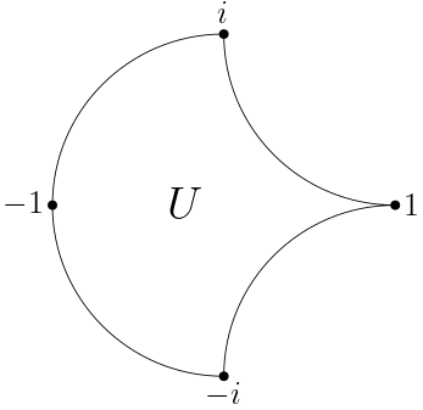
Boundary diagram of the region U: a curved region inside the unit disk with marked boundary points minus one, i, one, and minus i. The left arc follows the unit circle; two inward-curving arcs connect i to one and one to minus i.
Figure 1. Region U in Problem 5, with boundary points −1, i, 1, and −i.