Display Accessibility Tools

Accessibility Tools

Grayscale

Highlight Links

Change Contrast

Increase Text Size

Increase Letter Spacing

Readability Bar

Dyslexia Friendly Font

Increase Cursor Size

Geometry - August 2025

Directions

Do Problems 1–4, and then do two of the remaining Problems 5–7.

Make clear which problem you do NOT want graded. All manifolds, functions, vector fields, etc. are assumed to be smooth.

Problem 1.

Let S be the subset of R 4 defined by the equations

{ x 4 + y 4 + z 4 + 3 w 6 = 5 x + y + z = 0
  1. Prove that S is a submanifold of R 4 .
  2. What is dim ⁡ S? Is S compact?

Problem 2.

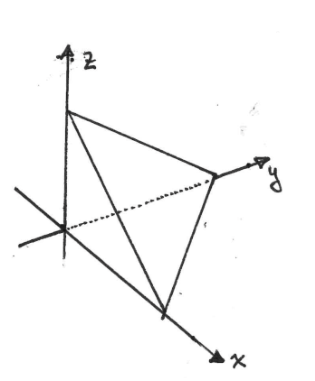
Let T ⊂ R 3 be the solid tetrahedron with vertices (0, 0, 0), (1, 0, 0), (0, 1, 0) and (0, 0, 1). The orientation form d x ∧ d y ∧ d z on T induces “outward normal” orientations on each of its faces. Using these orientations, evaluate

I = ∫ S d x ∧ d y + d y ∧ d z

where S = S 1 ∪ S 2 ∪ S 3 is the union of

S 1 = face in the xy-plane

S 2 = face in the xz-plane

S 3 = face in the yz-plane

Diagram of a tetrahedron with vertices at the origin and on the positive x, y, and z axes. Solid lines represent visible edges, and a dotted line represents a hidden edge.
Figure 1. Tetrahedron illustrating the solid region described in Problem 2.

Problem 3.

Let Ω p ( M ) denote the set of smooth p-forms on a smooth manifold M.

  1. The exterior derivative d is a linear map d : Ω p ( M ) → Ω p + 1 ( M ) for each p ≥ 0 such that:

    Fill in the blanks for (i)–(iii)

    1. d 2 = _____
    2. For f ∈ C ∞ ( M ), the 1-form d f is defined by d f ( X ) = _____ for all vector fields X.
    3. d ( ω ∧ η ) = ________________ ∀ ω ∈ Ω p ( M ) , η ∈ Ω q ( M ).
    4. d is local: for each p ∈ M, the value of d ω at p depends only on the restriction of ω to an arbitrarily small neighborhood of p.
  2. Show that Properties (i)–(iv) determine d ω for a 1-form ω. Hint: write ω in local coordinates.
  3. Use induction to prove that properties (i)–(iv) uniquely determine d ω for all p-forms ω.

Problem 4.

This problem is about the definition of vector fields as derivations. Complete the definitions:

  1. A vector field is a derivation, i.e. linear map X : C ∞ ( M ) → C ∞ ( M ) such that _____
  2. The bracket [ X , Y ] of vector fields X and Y is defined by _____
  3. Prove that your answer to (b) is a vector field.
  4. For a diffeomorphism F : M → M, the pushforward of X is the vector field F * X defined by _____

    One can show (you don’t have to) that

    F * [ X , Y ] = [ F * X , F * Y ] (1)
  5. Let F t be the flow of a vector field Z. Replace F by F t in (1) and differentiate with respect to t at t = 0 to obtain a formula involving Lie derivatives.
  6. Relate your formula in (e) to the Jacobi Identity.

Do TWO of the remaining three problems. Make clear which ones you chose.

Problem 5.

Let f : M → N be a submersion whose image is all of N. Prove that the pullback map f * : Ω p ( N ) → Ω p ( M ) is an injection.

Problem 6.

Let f : S 2 → M be a smooth map, where S 2 is regarded as the boundary of the unit ball B 3 in R 3 . Suppose that there is a DeRham cohomology class [ ω ] ∈ H 2 ( M ) with

f * [ ω ] ≠ 0 in H 2 ( S 2 ) .

Prove that f does not extend to a map f : B 3 → M.

You may use the fact that integration of 2-forms defines an isomorphism

H 2 ( S 2 ) ⟶ ≅ R .

Problem 7.

Let M be an n-dimensional manifold with boundary, and f : ∂ M → R a function on the boundary. Show that f extends to a smooth function on M, as follows.

  1. (Local extension). Fix p ∈ ∂ M. Show that there is a neighborhood U p of p in M and a map F p : U p → R with F | ∂ M ∩ U p = f.
  2. (Global extension). Use (a) and a partition of unity to show that there is a smooth map F : M → R such that F | ∂ M = f.