Topology - August 2024
Topology Qualifying Examination
M. Hedden, August 2024
Instructions: Solve four out of the five problems. Justify your claims either by direct arguments or by referring to theorems you know.
Problem 1
State and prove the Brouwer fixed point theorem.
Problem 2
Let be a CW complex constructed from the 1-complex shown here:
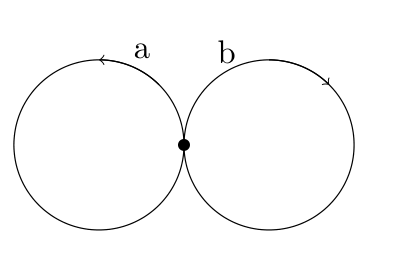
by attaching three 2-cells via attaching maps that traverse the loops , , and , respectively, and a single 7-cell (attached along any map)
-
Compute .
-
Prove that any map is homotopic to a constant map.
Problem 3
-
Let be any topological space. Using only the definition of singular homology, prove that is isomorphic to the free abelian group generated by the path components of .
-
Let denote the subspace of consisting of the coordinate axes; that is,
Prove there does NOT exist a homeomorphism sending the origin to the point . (Hint: Part (a) is there for a reason.)
Problem 4
Find all the connected covering spaces of . Justify your answer carefully. Which of these covering spaces are normal? Explain.
Problem 5
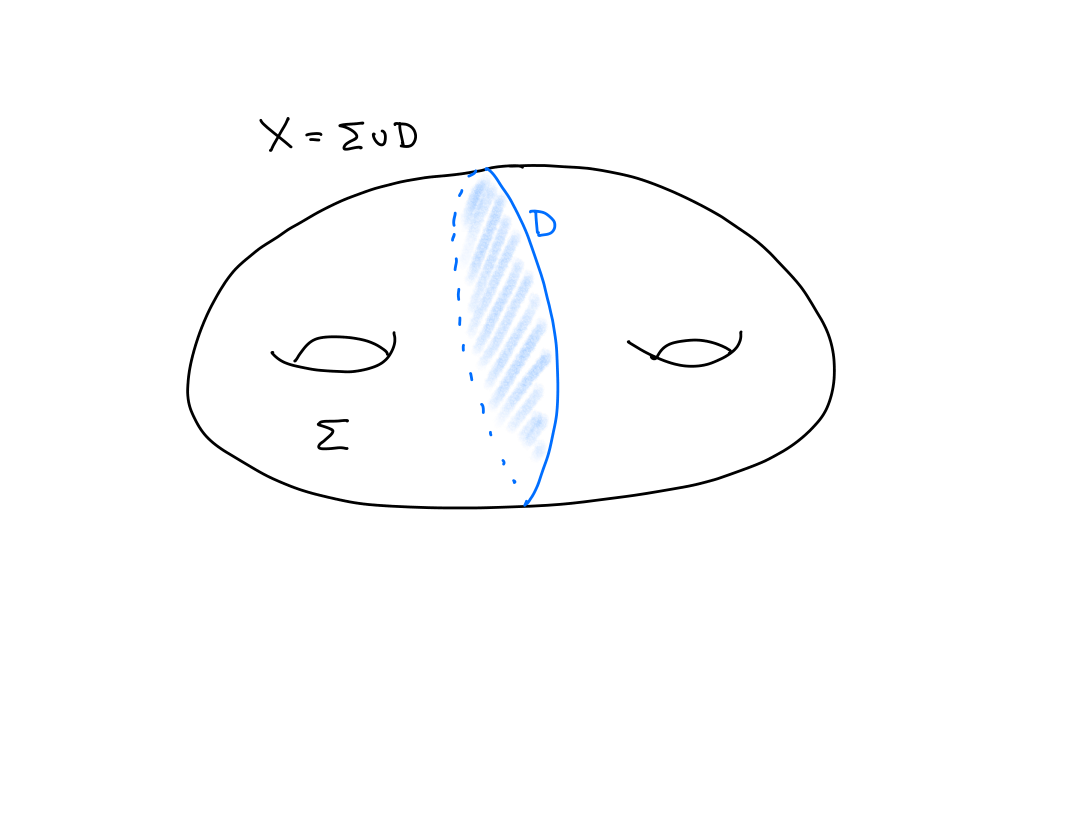
Let be the space consisting of a genus two surface and a 2-disk , meeting along a circle as shown in the figure on the following page. Calculate the homology groups for all .