Topology - January 2026
Instructions: Solve any FOUR out of the five problems. If you work on all five problems, your top four problem scores will count towards your exam score.
NOTE: No books, notes, or resources of any kind may be used during the exam.
All work must be shown, and all answers justified appropriately.
Problem 1
The fundamental group of a (based) space can also be described as the (based) homotopy classes of maps from the circle into . Analogously, one can define groups as the group of (based) homotopy classes of maps from into .
- Show that every map is nullhomotopic. This implies that the group .
- Prove that not every map is nullhomotopic. This implies that the group is nonzero.
Problem 2
- Explain how to construct a CW-complex with homology groups as follows:
- For the space you constructed in part (a), compute the cohomology groups .
- For a finitely generated abelian group , prove that .
Problem 3
- Describe the universal cover of .
- Is there a covering space of such that ?
- Let be a path-connected, locally path-connected, and semi-locally simply connected space. Prove that the universal cover of is unique up to homeomorphism.
Problem 4
- Give an example of two spaces that are homotopy equivalent but not homeomorphic. Justify your answer.
- Give an example of two spaces and such that for all , but and are not homotopy equivalent. Justify your answer.
Problem 5
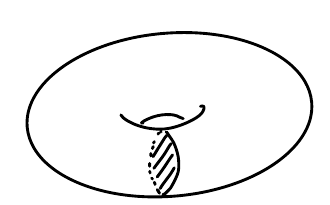
Let be the space obtained from the torus and the unit disk by identifying the circle with by a homeomorphism (see picture).
- Calculate .
- Calculate the homology groups of .