Topology - May 2021
TOPOLOGY QUALIFYING EXAM – MAY 2021
Instructions: Solve any FOUR out of the five problems. If you work on all five problems, your top four problem scores will count towards your exam score.
NOTE: The only resources you are allowed to use on this exam are the textbook for the course, any personal notes you have created (including old assignments), and the lecture notes for the course on D2L. You cannot use internet resources during this exam. In your solutions you should not use theorems from the book that are outside the scope of the material covered in this course.
All work must be shown, and all answers justified appropriately.
Problem 1
-
Let be a space that is path-connected, locally path-connected, and is a finite group. Show that for any such , every map is nullhomotopic.
-
True or False: For a space and map , if the induced map is the zero map, then the map is nullhomotopic. Justify your answer with a proof or a counterexample.
Problem 2
- Explain how to construct a CW-complex with homology groups as follows:
- For the space you constructed in part (a), compute the cohomology groups, .
Problem 3
Let denote the free group on generators.
-
Use covering space theory to prove that all index two subgroups of are isomorphic to .
-
Give an example of an explicit index 2 subgroup of that is isomorphic to .
Problem 4
Prove or find a counterexample for each of the following assertions:
-
If a space is the union of two subspaces and , then the fundamental group is a quotient of the free product .
-
For topological spaces , we have for all .
-
There is no retraction from the Möbius band to its boundary circle .
Problem 5
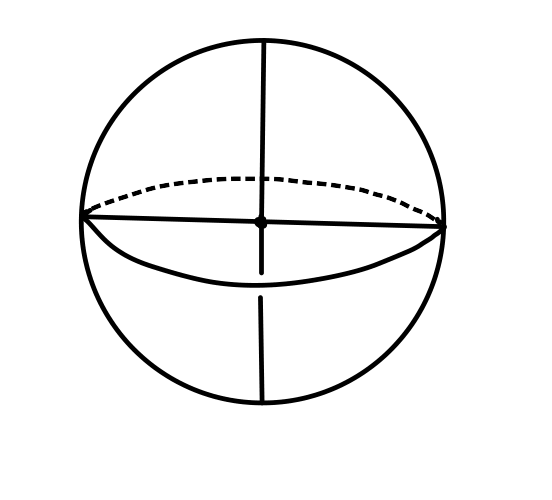
Let be the subspace of consisting of the unit 2-sphere and two diameters (see picture below). Compute the homology groups .