Topology - May 2023
TOPOLOGY QUALIFYING EXAM– SPRING 2023
Instructions: Solve any FOUR out of the problems. If you work on all problems, your top four problem scores will count towards your exam grade.
You have two hours to work on the exam. NOTE: In your solutions you should not use theorems from the book that are outside the scope of the material covered in this course. Show your work; all answers must be justified appropriately.
Problem 1
-
Prove that is not homeomorphic to for .
-
Let and (for ) be open sets. Show that is not homeomorphic to .
Problem 2
State and prove the Brouwer fixed point theorem.
Problem 3
Let be the free group on letters.
-
Show that if is an index 3 subgroup of then is isomorphic to . (Hint: Euler characteristic may be helpful)
-
Find a subgroup , with .
-
If , show is not isomorphic to .
Problem 4
-
Show that any continuous map is nullhomotopic.
-
Compute the homology groups when is or and is a finite set of points in .
-
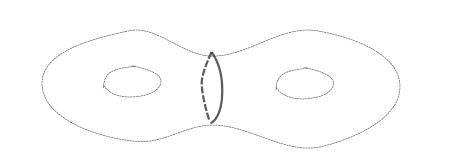
Compute the groups where is a closed orientable surface of genus two and is the (middle) circle shown.
Problem 5
-
Let be the torus. Describe a subspace of so that the induced map is an isomorphism. Show that .
-
Suppose that the subspace you chose in (1) has a neighborhood inside of so that deformation retracts to . Show that the quotient map collapsing the subspace to a point is not nullhomotopic by showing that it induces an isomorphism on . Hint: Use the long exact sequence of a pair.
-
True or False (justify your answer): For every matrix
there exists a homeomorphism so that the induced map is (with respect to the basis you chose in (1)).