Herzog Competition - 1976
Herzog Prize Examination — 1976
Exam date: November 6, 1976
Problem 1
(E.A. Nordhaus) In the figure below the eleven points represent cities, the twenty seven line segments represent the roads connecting these cities. If a salesman must travel only on the roads shown, prove that he cannot visit each city exactly once and return to the city from which he started.
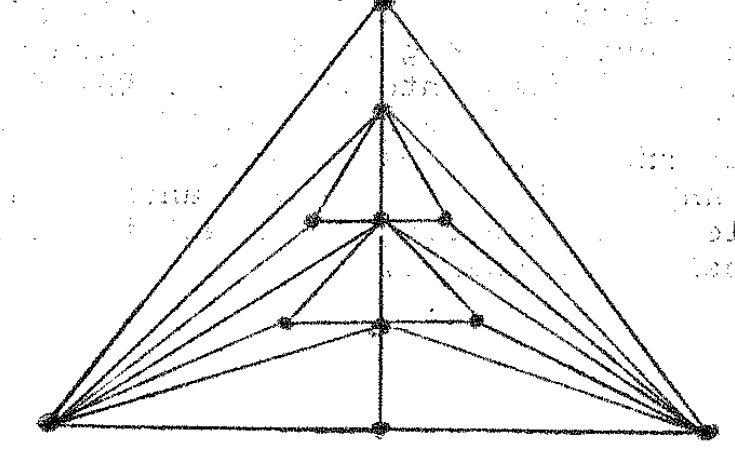
Problem 2
Suppose A is a point set in euclidean 3-space such that
- no line meets A in more than 2 points
- for every 3 points in A, the circle determined by these 3 points lies within A.
Characterize A.
Problem 3
(L.M. Kelly) Let g₁, g₂, g₃, ... be a sequence of real numbers such that 0 < gₖ < 1 and (1 − gₖ)gₖ₊₁ ≥ 1/4 for all k. Compute .
Problem 4
(L.M. Kelly) Let f and g be bounded and differentiable respectively on the interval [a,b] with g(a) = 0. Suppose also that on [a,b], |f(x)g(x) + 3g′(x)| ≤ |g(x)|. Find g.
Problem 5
Let P(x) be a polynomial of degree n with real coefficients. Prove that
can have at most n+1 real solutions.
Problem 6
(Anonymous) A camel loaded with a sack containing N bananas is poised on the edge of a field of N gophers. As the camel sways across the gopher field each gopher in turn runs up to the camel, reaches into the sack, and randomly extracts an object. If the object is a half banana, the gopher eats the banana and returns to his hole. If the object is a whole banana, he eats half and daintily places the uneaten half in the sack. How many whole bananas would one expect to find in the sack after the trip across the gopher field?