Herzog Competition - 1986
Herzog Prize Competition
November 1, 1986
Problem 1
A student was asked to produce the maximum and minimum values of
subject to the constraints . The student claimed the minimum to be and the maximum . Prove that the student cannot be right.
Problem 2
Let , . Prove that
Problem 3
Each row in an M x N matrix with real entries is monotonically decreasing. Suppose now that the entries in each column are reordered so that they are monotonically decreasing. Show that the rows of the resulting matrix will also be monotonically decreasing.
Problem 4
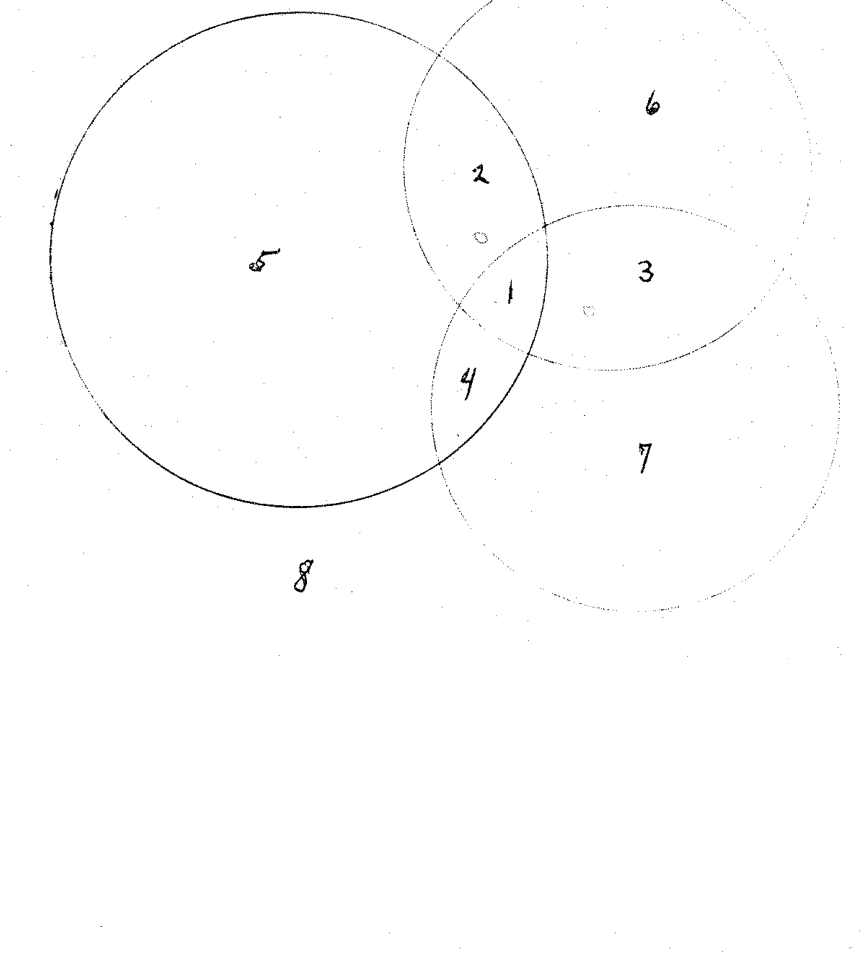
Three circles are arranged as shown partitioning the plane into eight regions. Prove that no line can intersect the interior of all eight regions. Clearly pinpoint any geometric assumptions that enter your argument.
Problem 5
v₁,v₂,v₃,v₄ are vectors in E³ with |vᵢ| > 1. Prove that the length of at least one of the vectors v₁ + v₂ + v₃, v₁ + v₂ + v₄, v₁ + v₃ + v₄, v₂ + v₃ + v₄ is greater than 1.