Herzog Competition - 1996
THE TWENTY-FOURTH HERZOG PRIZE EXAMINATION
November 16, 1996
Problem 1
Suppose that a set of six positive integers is given. Prove that it is always possible to choose a subset of them in such a way that the sum of the digits of all members of the subset is divisible by 5. Can the number “six” be improved upon?
Problem 2
If are real numbers satisfying and , prove that all three numbers are in the interval .
Problem 3
Find .
Problem 4
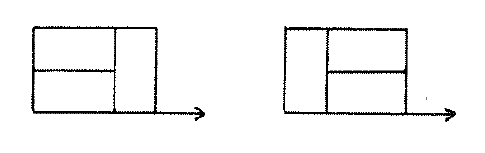
Find the total number of ways that an oriented rectangle can be paved with 1×2 tiles. (Since the rectangle is oriented, certain configurations are to be counted even if they seem to be duplicated by others congruent to them. For example the two tilings in the figure below are to be considered distinct.)
Problem 5
Let and be 2×2 matrices. Suppose that for some positive integers and , . Prove or disprove: there is a positive integer such that .
Problem 6
Prove that for every positive integer ,