Herzog Competition - 1997
THE TWENTY-FIFTH HERZOG PRIZE EXAMINATION
November 8, 1997
Problem 1
Prove or disprove: The next-to-last digit of a positive integral power of 3 is always an even number.
Problem 2
Prove: There are no integers such that is equal to 1 when and equal to 2 when .
Problem 3
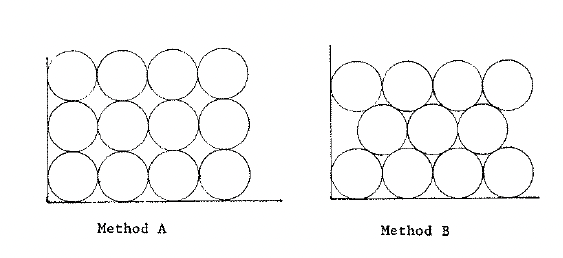
Pictured above are two ways to pack cans of soup in a shallow box. Obviously, method A enables the grocer to pack cans of unit diameter into an box. Find the smallest number for which method B enables the grocer to pack more than cans into an box.
Problem 4
Let be a differentiable function such that as . Prove that as well.
Problem 5
Find all pairs of positive integers satisfying .
Problem 6
Let and be a pair of positive real numbers satisfying .
a.) Prove that infinitely many such pairs of numbers exist.
b.) Prove that for any such pair, .