Integration Bee showcases MSU students’ calculus skills
The fourth annual Integration Bee, hosted by the Department of Mathematics, concluded recently with four undergraduates competing for a cash prize.
The Integration Bee, started in 2023 by Zhengfang Zhou, professor of mathematics at MSU, is designed to enhance students’ integration skills while fostering friendly competition. Eligible students had to complete MTH 133 (Calculus I) or its equivalent and be full-time MSU students to participate.
Four rounds of competition were held over five days, with 46 students participating.
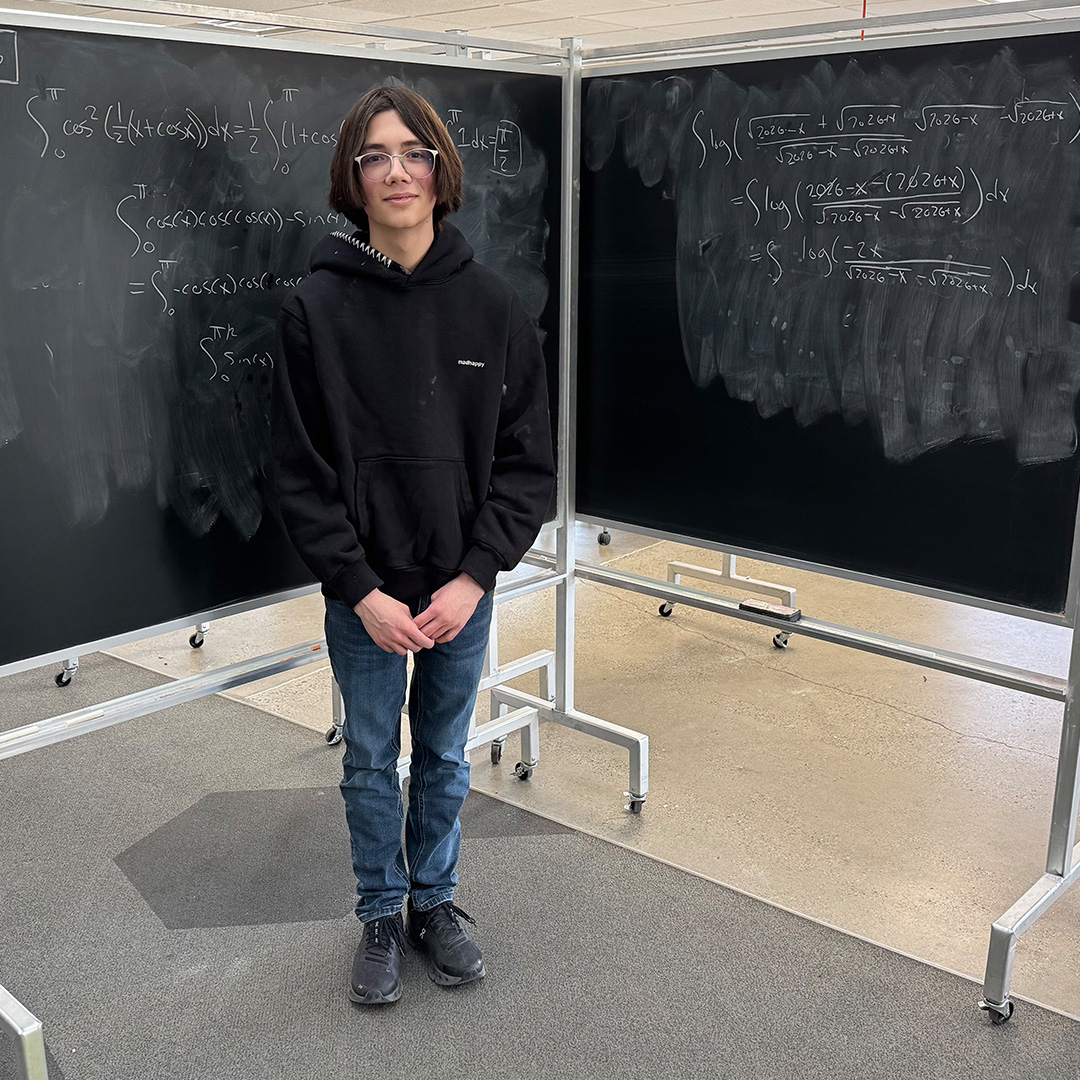
Cameron Oberg, a third-year student majoring in advanced mathematics and quantitative risk analysis, won the competition and earned the title of “Master Integrator.” Erik Brodsky, a fourth-year advanced mathematics and computational mathematics major, was the runner-up.
Second-year student Gavin O’Malley, who majors in advanced mathematics and physics, and Logan Bagdade, a fourth-year computer science major, were also finalists.
Ilya Kachkovskiy, associate professor of mathematics, saw the event as a good way to bring students together for a fun activity.
“While competing in Integration Bee requires some technical skills and a good command of calculus, in the big picture of mathematics I would consider it more of a fun intellectual and social activity which brings like-minded students together,” he said.
In the opening round Saturday, March 28, competitors were given 40 minutes to complete 15 online questions. Sixteen students were invited to advance to the second round Monday, March 30, which involved a 20-question in-person test. Thirteen students competed, with the top four participants advancing to the finals Wednesday, April 1.
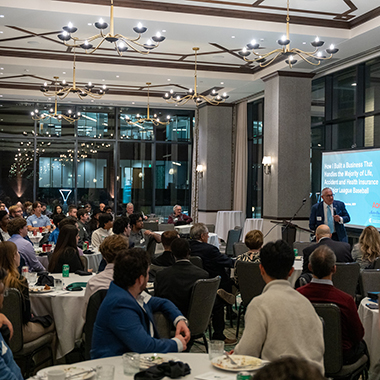
During the semifinal and final rounds, the four finalists competed against one another in front of an audience. Each contestant was offered four problems, and the winner was determined by who solved the most problems in 30 minutes.
Oberg solved three problems in 10 minutes to cruise to a victory during his semifinal match against Bagdade, while Brodsky edged out O’Malley by a 2-1 margin.
According to Kachkovskiy, Oberg’s quick solutions in the semifinals had organizers on edge and wondering if they had enough problems to present. Fortunately, the field was slowed down with problems proposed by Rajesh Kulkarni, professor of mathematics.
The problems used in the competition came from a collection from previous years that had not been used, as well as new problems that organizers had developed.
In the finals, Oberg and Brodsky solved one problem each before time was called. Oberg was declared the winner because he was the first to reach a solution during the match.
All four finalists will be recognized at the department award ceremony held at the end of the semester. They will also receive the following prizes: $800 for the master integrator, $400 for the runner-up and $200 each for the remaining two participants.
The Integration Bee was supported by several members of the math department’s faculty and staff. Kachkovskiy noted appreciation for all who helped, including fellow organizers Rajesh Kulkarni, Christian Parkinson and Yuliia Yershova. Ryan Maccombs and Devin Schnepp aided with the online round, while Burak Hatinoglu and Peter Magyar refereed the final day of competition.